Which Homes Took Water This Week? Now You Can Just Ask.
Palm Beach has been dealing with king tides. We described what we wanted in a few sentences, and about eleven minutes later TotalGTM had the 751 homes that likely took water this past week. Here's how flood and restoration teams can do the same.
If you sell flood barriers or do water restoration, two lists are worth more than anything else:
- Who took water this week: the people to follow up with now.
- Who will take water next time: the people to talk to before it happens.
The information to build both lists is out there. Government gauges measure the rivers and tides every few minutes, and there are detailed maps of how high every piece of ground sits. But turning that into a list of street addresses has always taken a mapping expert and a lot of time.
Now you can just describe what you want.
What we did in Palm Beach
Palm Beach has been dealing with king tides. Here’s exactly what we did inside TotalGTM, the same way you would:
- Added Palm Beach County. About six minutes later, nearly 600,000 homes were ready.
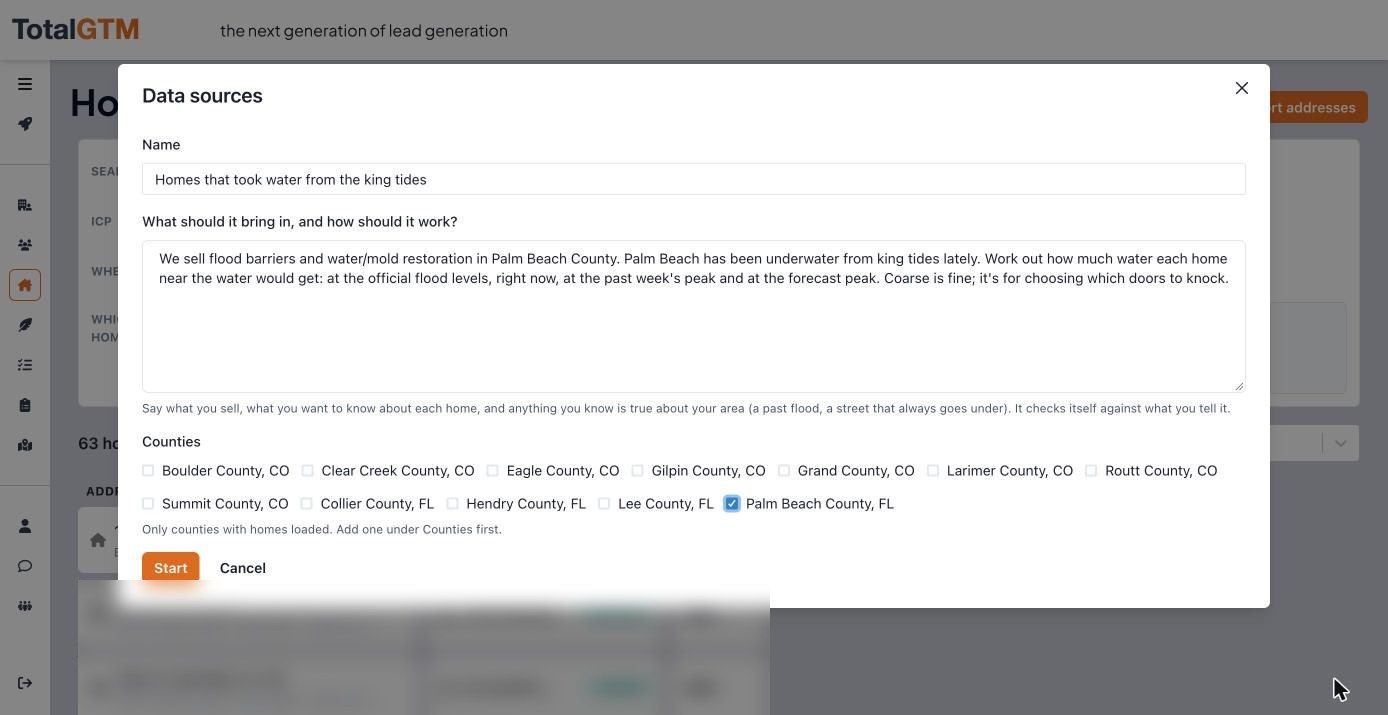
- Opened Homes → Data → Import with the agent and described what we wanted, plus a few things we know about the area:
“We sell flood barriers and water/mold restoration in Palm Beach County. Palm Beach has been underwater from king tides lately. Work out how much water each home near the water would get: at the official flood levels, right now, at the past week’s peak and at the forecast peak. Coarse is fine; it’s for choosing which doors to knock. What we know: on an ordinary day at a normal tide nobody’s home takes water. The worst recent king tide flooded low streets along the Intracoastal and in the Town of Palm Beach. Upper-floor condos don’t flood.”
- Waited about eleven minutes while it worked. It found the tide gauges along the coast, worked out what their readings mean for each house, and kept checking its numbers against what we’d told it. You can watch each step in plain English. At one point it noticed that “741 homes showed water right now on an ordinary tide. That cannot be right.” It worked out why and fixed it.
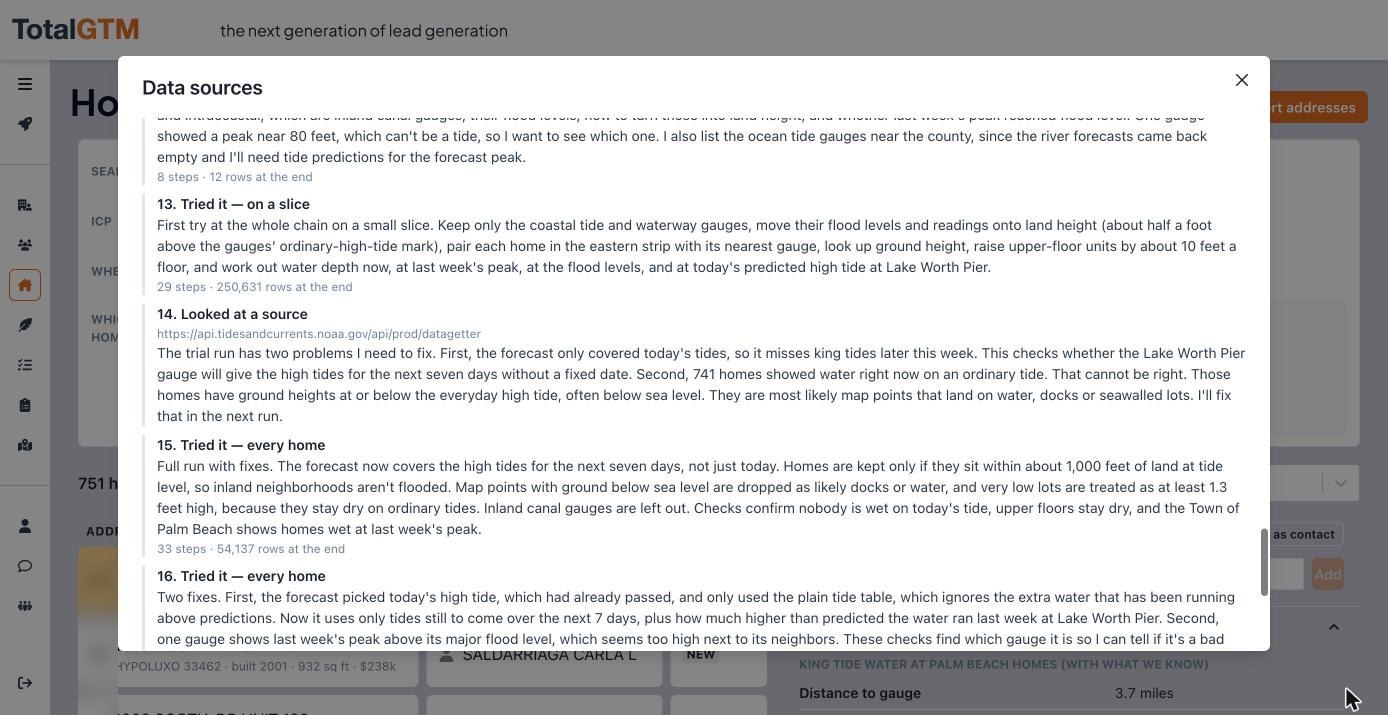
- Read what it found and clicked Load.
Then we searched for homes with water at last week’s peak.
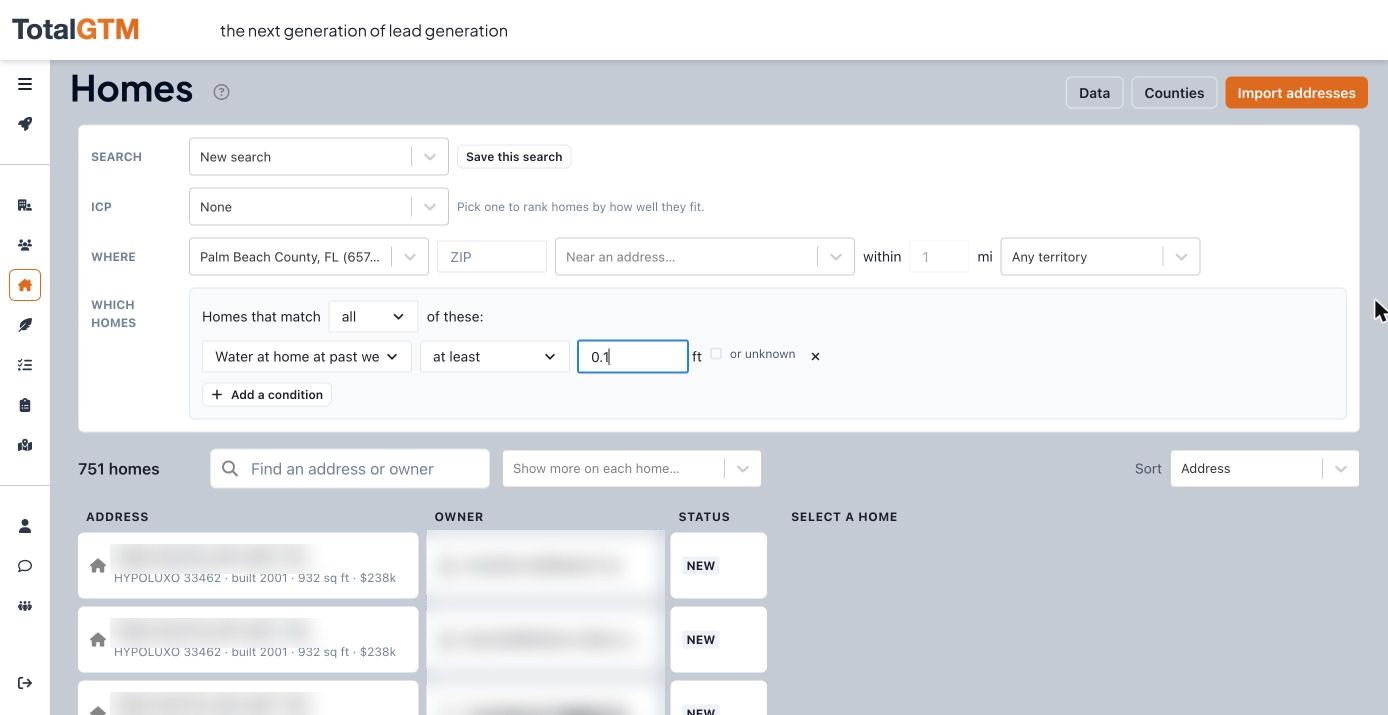
751 homes. That’s this week’s follow-up list. None of them are wet right now at low tide, and no upper-floor condos made the list. Another 369 would take water at next week’s highest tide. Open any home to see roughly how much water reached it.
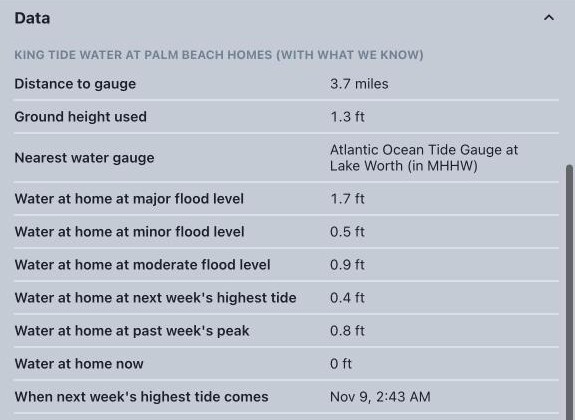
It tells you when something might be off
A tool that sounds confident and is wrong is worse than no tool. So before you load anything, TotalGTM shows you what might be wrong.
The agent lists its own doubts. Then a second, skeptical review reads the results the way a careful colleague would. It compares them with what you said and with earlier imports, and flags anything that doesn’t add up.
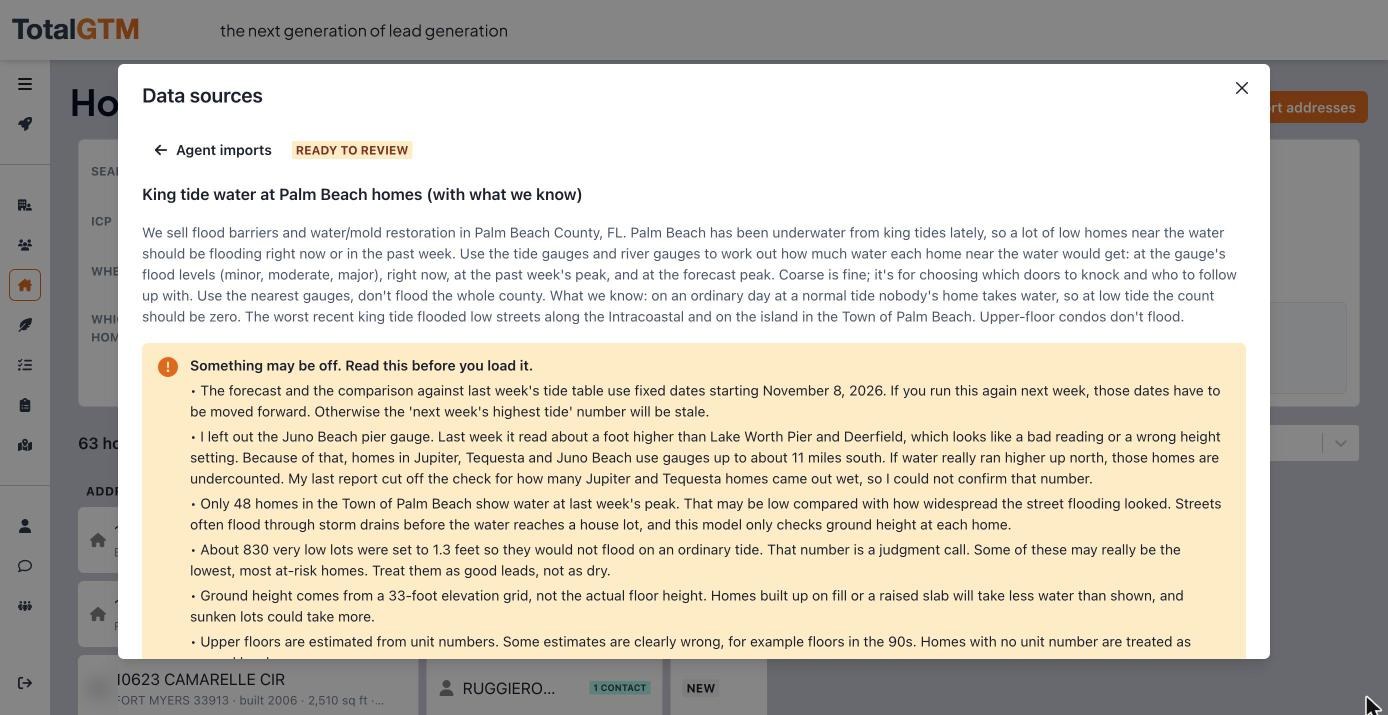
For this Palm Beach import it pointed out a few things worth knowing:
- Next week’s forecast uses one tide gauge for the whole coast.
- West Palm Beach looked low next to the Town of Palm Beach.
- The very lowest lots were a judgment call, so treat them as good leads.
None of that stopped us loading it. It just tells us where to look twice.
It earns its keep when a run goes wrong. One of our test runs, without the “what we know” sentences, said 306 homes were underwater at low tide. That’s the kind of mistake you’d never want to knock doors on, and now it’s the kind of thing it calls out.
Tell it what you know about your area
That’s the biggest lesson from building this: tell it something you know is true.
In Palm Beach, one sentence (“on an ordinary day nobody’s home takes water”) was enough for it to catch its own mistake.
We saw the same in Colorado, where the 2013 floods destroyed about 200 homes in the town of Lyons. When we just described the job, it found 35. When we added “in 2013, Lyons lost about 200 homes”, it checked itself against that, found what it had missed, and came back with 187.
So mention the flood everybody remembers, the street that always goes under, or the storm that hit last spring. You know your area better than any map does.
Not just floods
The same box works for other kinds of public data:
- Soil type for foundation and basement work.
- Tree cover for roofers and gutter crews.
- Wildfire areas for smoke and fire restoration.
Describe what you want and what it should mean for your business, and it works out how to bring it in.
What it doesn’t do yet
We’d rather you hear it from us:
- Updates: for now these lists don’t update on their own. Click Run it again when you want fresh numbers. Automatic updates are coming.
- It’s a good guess, not a survey. Seawalls, drains and how high the front door sits aren’t in the maps. It’s built for deciding where to knock, and it’s very good at that.
Try it
Go to Homes → Data → Import with the agent. Write a few sentences:
- What you sell.
- What you want to know about each home.
- Anything you know about your area.
Then let it work, and read what it flags before you load.
New to TotalGTM for home services? Start here.
Keep reading
- Before and After Postcards From a Photo of Their Home
Make before and after postcards from a photo of the homeowner's own house. Roofing direct mail you print or send yourself, each picture labeled an illustration.
- How to Find Homes With Pools From Aerial Imagery
Find homes with pools from aerial imagery, one lot at a time. The import agent checks each lot for a pool or a dock and tells you when the picture was taken.
- A Mobile Sales App to Work Your Leads One at a Time
A mobile sales app for B2B reps: pick a list, read a short brief before you call, ask about the person, get a draft in your voice, and tap what happened.