Sales Software Data Security: How TotalGTM Keeps It Apart
Sales software data security in plain words: how TotalGTM walls off each organization in the database, encrypts your keys, backs up nightly and handles Gmail.
Before you put your pipeline into a new tool, someone will ask: who else can see this?
It’s a fair question, and it’s the heart of sales software data security. Your contacts, your research on target accounts and your outreach show exactly who you’re going after and how. In a shared app, many companies’ data sits side by side. You need to know what keeps yours apart.
Here’s how TotalGTM handles it, in plain words. Everything below describes how the product works today.
Everything you make belongs to your organization
In TotalGTM, you work inside an organization. Every contact, company profile, ideal customer profile, landscape, sequence and note you create belongs to it.
That isn’t left to chance. If a record ever reached the database without an organization, it would be filed under its owner’s organization and our team would be alerted to fix the cause. A record with no owner and no organization is refused.
Multi-tenant data isolation, enforced by the database
Most apps keep customers apart with checks in their own code. We have those too. But code has bugs, and one missed check is all it takes.
So we added a second wall underneath. Every table that holds customer data has a rule built into the database: when you, or a job running for you, asks for data, the database only returns your organization’s rows. It also refuses to write a row into any other organization.
That means even if our own code asked for another organization’s records by mistake, the database would refuse to return them. The rule covers every query, including the quick “is this mine?” checks that are easy to get wrong.
Access is checked on every request
To use TotalGTM in an organization, you need a seat there, and the organization’s plan or trial has to be current. That’s checked on every request, not just when you sign in.
Without a seat, you can sign in, see which organizations you belong to and accept an invite, but you can’t open your organization’s work.
Sharing inside your team has clear rules
Inside your organization, you can share work with a group. Group members can work on what’s shared with them. A team working the same accounts can update the same contacts.
Deleting is different. Only the person who made something can delete it. A teammate can’t remove a landscape or deep dive you built.
The keys you give us are encrypted
Some features need keys or permissions from you:
- your own AI provider key
- keys for contact databases you connect
- the permission to send email from your Gmail
We encrypt all of these with AES-256-GCM before we store them. GCM is a mode of AES that NIST describes as authenticated encryption: it keeps the value secret and shows if anyone tampered with it. The key that unlocks them is kept apart from the database, as the OWASP Secrets Management Cheat Sheet recommends. A copy of the database on its own, such as a backup, holds no usable keys.
Our platform’s own secrets, such as the keys we use to run the service, are encrypted at rest on our servers too.
Connector sign-ins are stored as one-way hashes
If you connect TotalGTM to Claude, Claude holds a sign-in token for your account. We don’t keep a copy of that token. We store only a one-way hash of it, and of the short-lived code used to issue it. When Claude sends the token, we hash it and look up the match. A copy of what we store can’t be used to sign in.
Nightly backups, encrypted before they leave
Every night we back up the database, the files you upload and the platform’s settings. Each backup is encrypted on our servers before it leaves, then stored with a separate storage provider. The key that decrypts it is never given to that provider, so it can’t read your data. We keep each backup for 14 days, and we test restoring from them.
Gmail can send, and that’s all
When you connect Gmail to send your sequence emails, TotalGTM asks Google for one permission: to send email. It doesn’t ask to read your mailbox, so it can’t. You can read more in send sales emails from your own Gmail.
Contact data comes from your own account
If you connect Hunter to find work emails, or Tracerfy to look up home owners, every lookup runs on your own account with them, and they bill you directly. We don’t keep a shared pool of contact data across customers, and we don’t resell what you look up.
With your own AI key, prompts go to your provider
You can connect your own key from Anthropic, OpenAI, Google or xAI. When you do, TotalGTM does its research and writing for your organization with that provider, under your account and your terms with them. You pay them directly. We explain how in bring your own AI key for sales prospecting.
If you’d rather not manage a key, you can use TotalGTM’s models with credits instead. Either way, you choose.
You can see who used what
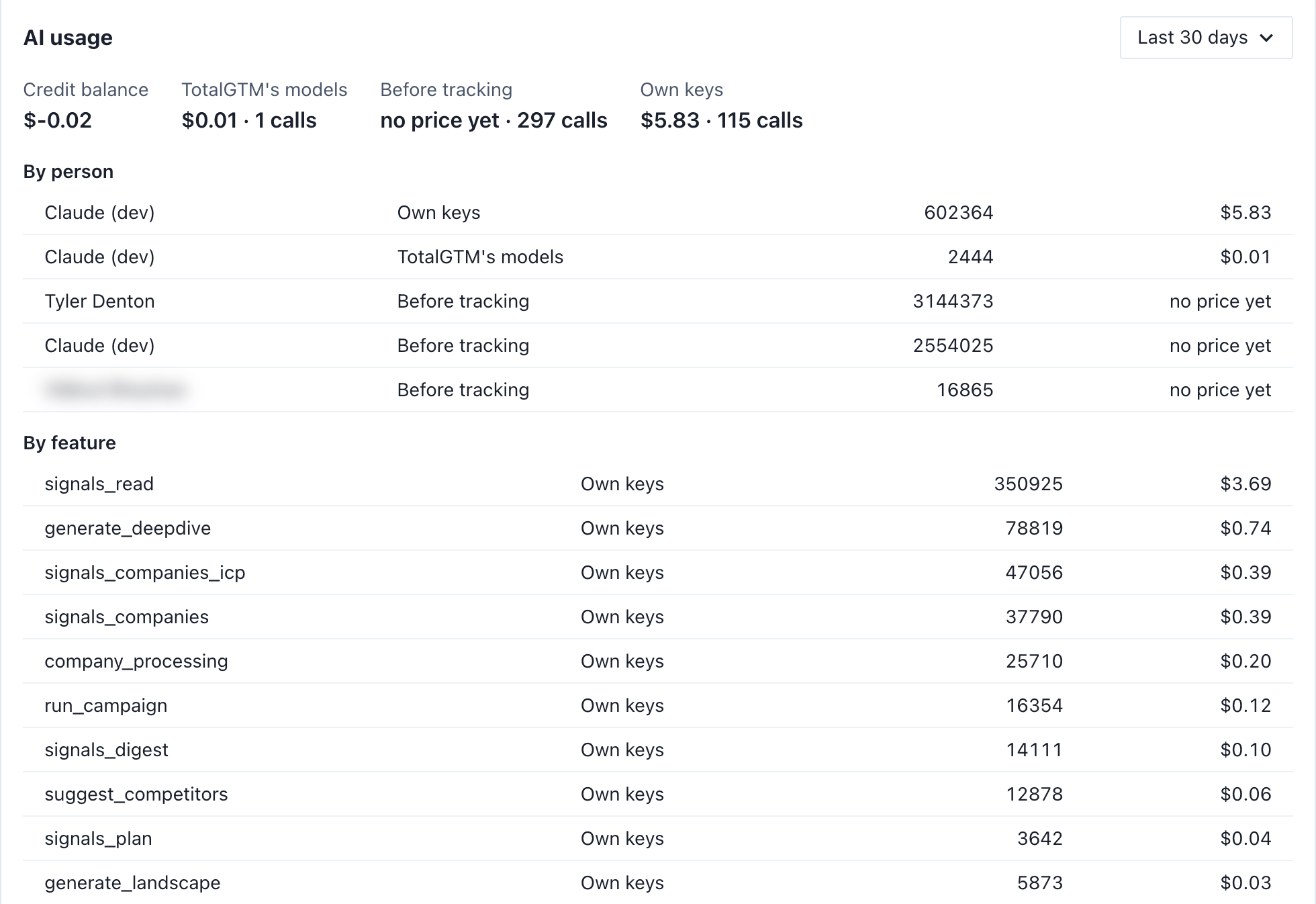
Every AI call is recorded with who made it, what feature it was for, and which model ran it. Your organization’s admin can see usage by person, by feature and by model under Organization, Billing & usage.
When the boundary has to be yours
For some teams, a shared app isn’t an option, however well it’s walled off. TotalGTM can also run as a private instance just for you, or inside your own cloud or data center. We explain the options in how to deploy TotalGTM in your environment.
Sales software data security: questions from your security team
Everything above describes how the product is built today. If your review needs more detail, ask us and we’ll answer directly.
Frequently asked questions
Is my CRM data safe in TotalGTM?
Every record belongs to your organization, and the database itself refuses to return or write another organization's rows, even if our own code asked by mistake. Access is checked on every request, not just at sign-in.
How does TotalGTM do multi-tenant data isolation?
Each organization's data is kept apart twice: by checks in our code, and by a rule built into every table that holds customer data. That rule only returns your organization's rows and refuses writes into any other organization.
Are my API keys and Gmail connection encrypted?
Yes. AI keys, contact database keys and Gmail tokens are encrypted with AES-256-GCM before they're stored, and the key that unlocks them is kept apart from the database. A backup of the database alone holds no usable keys.
Is my data backed up?
Yes. Every night we take encrypted backups and store them with a separate storage provider. They're encrypted before they leave our servers, with a key that provider never holds.
Does TotalGTM sell or share my contact data?
No. Contact data from Hunter or Tracerfy always comes from your own account with them, and it isn't pooled with other customers or resold.
Keep reading
- Shared SaaS, Dedicated, or Your Own Data Center: How TotalGTM Deploys
TotalGTM runs three ways: managed multi-tenant SaaS, a single-tenant dedicated instance, or fully self-hosted in your own cloud or data center with local AI. Here's how to choose.
- Set Up an AI SDR in Minutes, With a 30-Day Free Trial
Sign up for TotalGTM, the AI SDR that researches accounts and drafts outreach. Every setup step, from your free trial and AI key to your first landscape.
- Before and After Postcards From a Photo of Their Home
Make before and after postcards from a photo of the homeowner's own house. Roofing direct mail you print or send yourself, each picture labeled an illustration.